IJET
About the Journal
Journal Information
| Original title | : | Indonesian Journal of English Teaching |
| English title | : | Indonesian Journal of English Teaching |
| Short title | : | IJET |
| Frequency | : | 2 issues per year (July and December) |
| No. of articles per issue | : | 10 articles |
| DOI | : | https://doi.org/10.15642/ijet2 |
| ISSN | : | 2548-6497 (online) & 2302-2957 (printed) |
| Editor-in-Chief | : | Mokhamad Syaifudin |
| Citation Analysis | : | Sinta, GScholar, Garuda |
| Subject Area | : | Social Sciences |
| Category | : | Education, Linguistics, and Language |
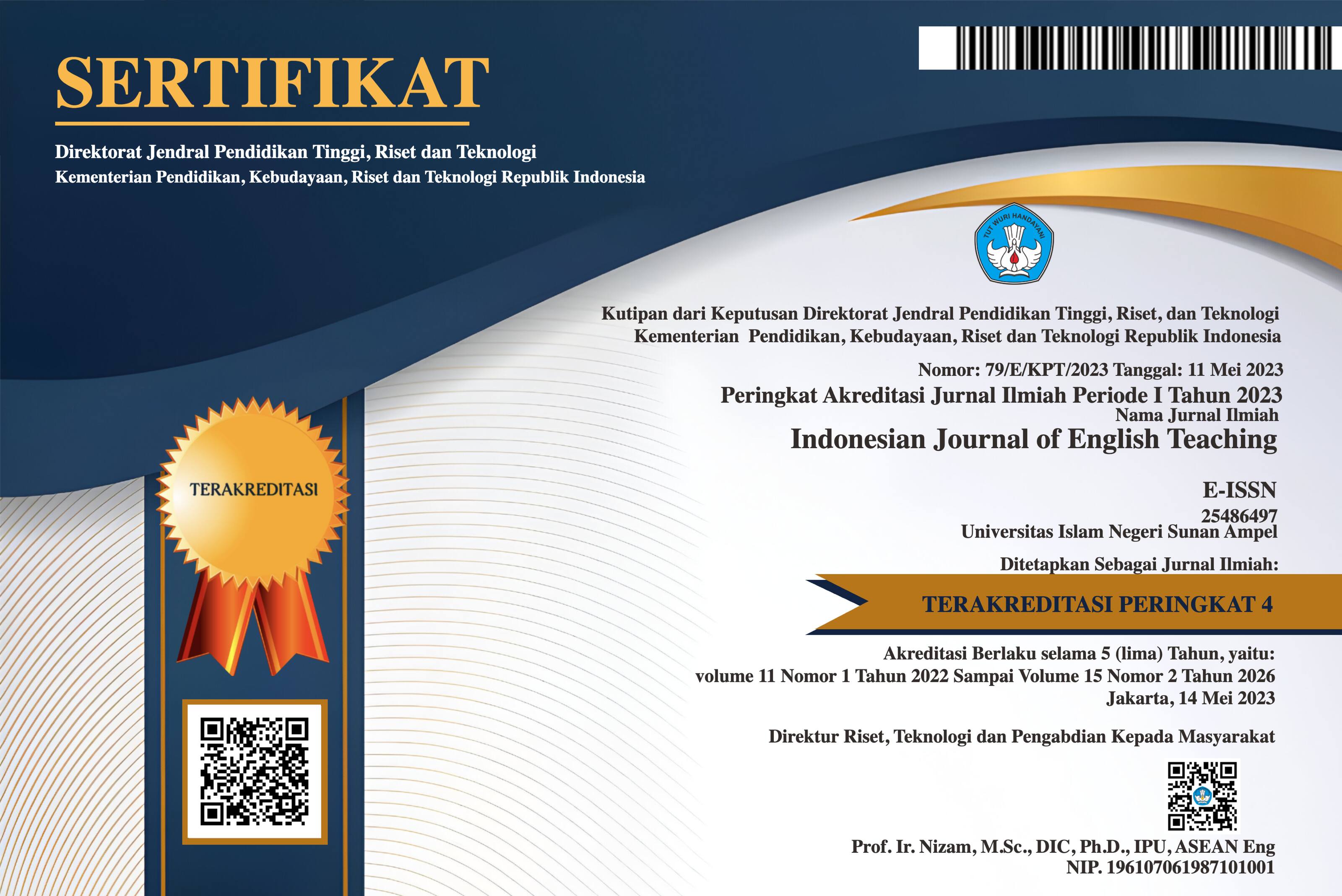
The Indonesian Journal of English Teaching (IJET) is a journal for sharing research and new ideas in English Language Teaching (ELT). It provides significant exposure for impactful work, reaching a wide global audience of English teachers, lecturers, professors, and practitioners working with students of all ages in various ELT settings like EFL, ESL, ESP, and EAP. IJET's quality is recognized through its indexing and abstracting in respected databases such as Google Scholar, Garuda, DOAJ, Moraref, Indonesia One Search (IOS), and BASE (Online ISSN: 2548-6497; Print ISSN: 2302-2957), as well as its recent reaccreditation by the National Journal Accreditation (ARJUNA) under decree No. 79/E/KPT/2023. For detailed information about the journal's focus and scope, please visit the 'About Journal' section. Professionals in ELT are encouraged to consider IJET as an important channel for disseminating their research and connecting with a worldwide community of scholars and practitioners
Starting from January 1, 2024, the Indonesian Journal of English Teaching has been redirected from https://jurnalftk.uinsby.ac.id/index.php/IJET to https://jurnalftk.uinsa.ac.id/index.php/IJET.
Current Issue
Vol. 15 No. 1 (2026): July
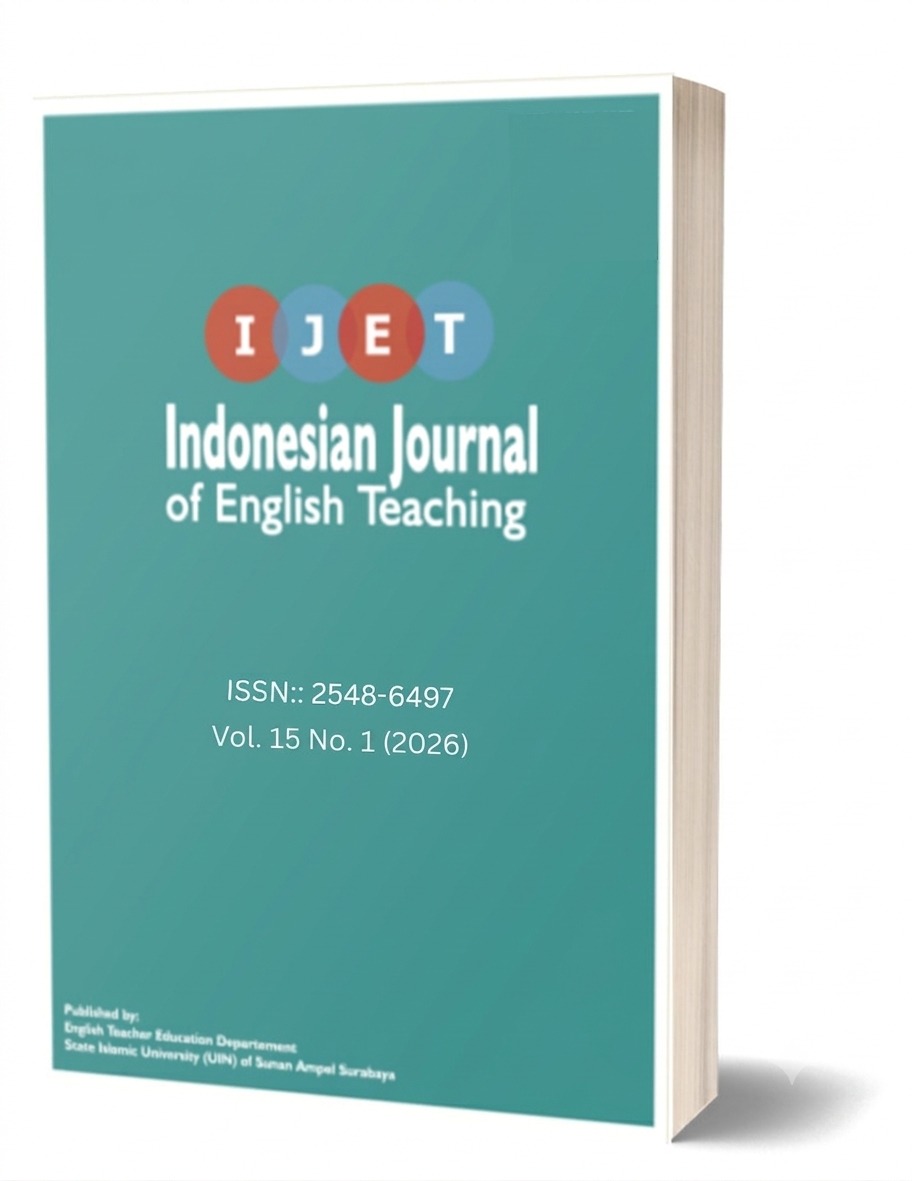
This issue of the IJET highlights a range of studies that capture current developments in English language education, particularly in the use of digital media, innovative classroom practices, and learner-centered approaches. The articles explore how digital tools such as the Let’s Read application, interactive flipbooks, digital comics, podcasts, and the Eng Venture application can support different aspects of language learning and digital literacy. The issue also features research on student-authored publications as a strategy for strengthening learning outcomes in higher education and examines how personality factors, particularly neuroticism, may influence students’ speaking performance in international lecture settings. The findings offer practical perspectives for teachers and researchers seeking to develop more engaging, relevant, and responsive learning experiences.
Published:
2026-07-31
Articles
_______________________________________________________________________________________________________________
IJET (Indonesian Journal of English Teaching) indexed and abstracted by:
 |
 |
 |
 |
 |
|
 |
 |
 |
|
|
|